The Biggest SEO Mistake Businesses Still Make
What’s the biggest mistake companies make with the SEO? Most businesses still focus on keywords and technical tweaks while ignoring search intent, user experience, and content quality.
Companies treat SEO as a one-time task rather than an ongoing strategy; optimising a website once, then expecting results to compound indefinitely without consistent effort, fresh content, or technical keep up. The real fix is to treat SEO as a growth system, not a checklist.
This blog breaks down the most damaging SEO mistakes businesses still make in 2026, why small businesses SEO strategies fail so consistently, and what fixing them actually looks like in practice.
For businesses that want SEO done properly from the start, Arismeta’s Digital Marketing and SEO team builds organic search strategies that are grounded in fundamentals, not shortcuts.
Why Most Businesses Still Get Basic SEO Fundamentals Wrong
The biggest mistake companies make with SEO is not always the dramatic one. It is usually the most basic; and it is almost always rooted in a misunderstanding of what SEO actually is.
Most businesses approach SEO as a technical problem. Fix the meta tags, add some keywords, submit the sitemap, and wait. When rankings don’t move, they assume SEO doesn’t work for their industry. What's actually happening is that they’ve addressed the surface layer while ignoring the factors that drive sustained organic growth.
The fundamentals most businesses consistently get wrong:
Keyword intent mismatch:
Targeting keywords based on search volume alone without understanding what the user actually wants to find. A page optimised for a transactional keyword but structured like an informational article will not rank for either.
Content created for search engines instead of people:
Stuffing keywords into thin, low value content that technically covers a topic but gives the reader no reason to stay, engage, or return. Google's quality signals have evolved significantly; this approach actively hurts rankings in 2026.
Ignoring E-E-A-T signals:
Experience, Expertise, Authoritativeness, and Trustworthiness are the framework Google uses to evaluate content quality. Businesses publishing anonymous, uncredited content with no clear author expertise are missing one of the most important ranking factors available to them.
Building links before building content:
Acquiring backlinks to pages that don’t deserve them because the content itself adds no value. Links amplify what’s already there; if the content is weak, links accelerate its failure, not its success.
Treating SEO as a campaign, not a channel:
Running three months of SEO activity, seeing partial results, stopping, then wondering why rankings declined. SEO compounds over time interrupting that compounding is the single most reliable way to guarantee poor long-term returns.
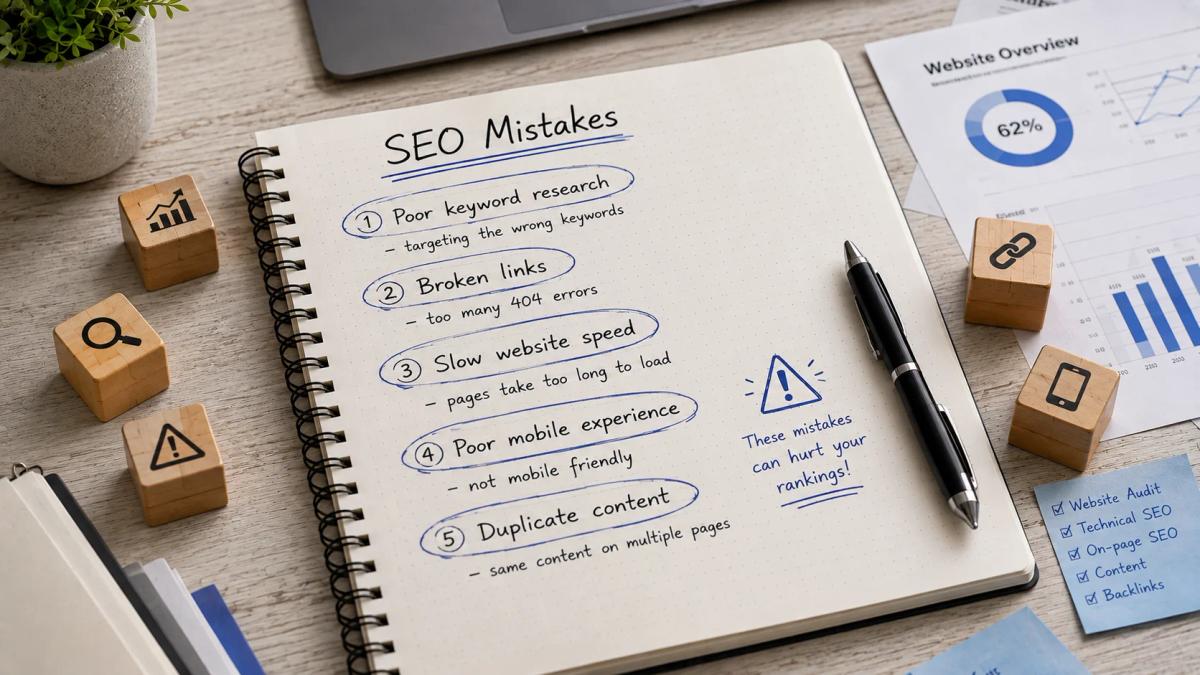
5 Common SEO Mistakes that Hurt Your Rankings
1. No clear topical authority
Publishing scattered content across unrelated topics instead of building deep, interconnected coverage around a core subject area. Google rewards sites that demonstrate genuine expertise in a specific domain, not sites that cover everything shallowly.
2. Thin or duplicate product and service pages
Every page on your website competes for rankings independently. Service pages with two paragraphs of generic copy, product pages with manufacturer descriptions, and location pages built from a copied template are all active drags on your domain’s overall search performance.
3. Ignoring technical SEO after launch
Slow page speed, broken internal links, crawl errors, missing canonical tags, and unoptimized Core Web Vitals do not fix themselves. Technical health degrades over time as a site grows and most businesses only discover how bad it has gotten when rankings drop significantly.
4. No internal linking strategy
Internal links distribute page authority across a website and help google understand the relationship between pages. Most businesses add internal links reactively and inconsistently which means their most important pages are often the least connected and the hardest for google to find and prioritise.
5. Measuring Vanity metrics instead of business outcomes
Tracking keyword rankings and organic sessions without connecting them to leads, revenue, or customer acquisition cost. SEO that produces traffic, but no business outcome is not successful strategy; it is an expensive content operation with no accountability.
How to Fix the Biggest SEO Mistakes in 2026
Fixing SEO mistakes is not about chasing algorithm updates. It is about building foundations that every algorithm update rewards consistently. Here's what that looks like in practice:
Start with a technical audit, not content.
Before producing a single new piece of content, understand the technical state of your website. Crawl errors, redirect chains, duplicate content, and speed issues all suppress rankings regardless of how good your content is. Fix the foundation first.
Define your topical authority.
Pick the three to five core topics your business should own in search. Build a content map that covers those topics at every level of depth; broad awareness content, specific informational content and conversion focused content; all interconnected through intentional internal linking.
Rewrite your weakest existing pages before creating new ones
Most websites have ten to twenty pages that rank on page two or three for valuable keywords. Improving those pages; adding depth, improving structure, strengthening calls to action which often produces faster ranking movement than creating entirely new content from scratch.
Build content with demonstrated expertise
Add author bios, cite real experience and case studies, and ensure that every piece of content reflects genuine knowledge of the subject. In 2026, anonymous generic content is losing ground to content that demonstrates real human expertise and first-hand experience.
Set a measurement framework before any work begins
Define which metrics matter; qualified organic leads, revenue from organic traffic, or cost per acquisition from SEO and setup tracking that connects organic performance to those business outcomes. SEO without measurement accountability drifts quickly towards activity for its own sake.
Why Most SEO Strategies Fail for Small Businesses
Small business SEO fails for a consistent set of reasons that have less to do with budget and more to do with approach.
Expecting results too quickly: SEO is a six-to-twelve-month minimum investment for most competitive keywords. Small businesses that evaluate SEO success after eight weeks are measuring the wrong thing at the wrong time.
Hiring on price rather than fit: The cheapest SEO provider is rarely the right SEO provider. Low-cost SEO typically means low-quality content, automated link building, and no strategic thinking which produces short term ranking movement followed by penalties or collapses.
No consistency of effort: Publishing four blog posts and then going quiet for three months. Running an SEO campaign for one quarter and pausing one budget is tight. SEO rewards consistency more than intensity; irregular effort produces irregular results.
Competing for keywords they cannot win yet: Targeting the most competitive terms in a category before building the domain authority needed to rank for them. A new website cannot rank for “best SEO agency in India”; but it can rank for twenty more specific, lower competition terms that build towards it over time.
No integration between SEO and other marketing channels: SEO does not work in isolation. Content produced for SEO should be distributed through social, email, and paid channels. Businesses treating SEO as a separate function from the rest of their marketing consistently underperform against those treating it as a core channel connected to everything else.
Explore Arismeta’s full-service SEO and Digital Marketing capabilities to see what an integrated organic search strategy looks like for a business at your stage.
How Arismeta Helps Businesses Stop Repeating Costly SEO Mistakes

Arismeta works with businesses that have either never invested in SEO properly or have invested and not seen the results they expected. Both situations have the same starting point; a clear audit of what’s actually happening before any new work begins.
Every SEO engagement starts with a technical audit, a content gap analysis, and an honest assessment of where the domain currently stands relative to where the business needs it to be. From there, a prioritised roadmap is built; addressing the highest impact issues first rather than spreading effort across every possible optimisation simultaneously.
Reporting is built around business outcomes, not just keyword rankings. Traffic that doesn’t convert is not a success metric. Every engagement is measured against the thing that actually matters; qualified organic growth that contributes to revenue.
Learn more about Arismeta’s approach and the team behind every SEO engagement and find out what a properly structured organic search strategy looks like for your business in 2026.
FAQs
1. What is the biggest mistake companies make with SEO?
The single biggest mistake is treating SEO as a onetime task rather than an ongoing strategy. Businesses that optimise their website once and expect compounding results without continued effort, fresh content, and technical maintenance consistently underperform against those that treat SEO as a sustained growth channel.
2. Why is my website not ranking despite doing SEO?
The most common reasons are keyword intent mismatch, thin or duplicate content on key pages, unresolved technical issues suppressing crawlability, insufficient topical authority, and an inconsistent publishing or link building effort. A technical audit and content gap analysis typically surface the primary cause within the first two weeks of investigation.
3. How long does SEO take to show results for small businesses?
Most small businesses see initial keyword movement within three to four months of consistent, well-structured SEO work. Meaningful organic traffic growth typically appears between six and twelve months. Competitive industries take longer; local and niche markets with lower competition often move faster.
4. Why do most small business SEO strategies fail?
The most consistent reasons are expecting results too quickly, hiring the cheapest available provider rather than the most appropriate one, inconsistent effort over time, targeting keywords that are too competitive for the domain’s current authority, and failing to integrate SEO with the broader marketing strategy.
5. What should a business do before investing in SEO?
Before spending on SEO, complete a technical audit of your existing website, identify your core topical territory, ensure your analytics and tracking are setup correctly, and define the business outcomes you expect SEO to contribute to. Investing in SEO without these foundations in place produces slower results and makes it harder to evaluate whether the work is succeeding.